Types of chimneys: what are they and which one to choose?
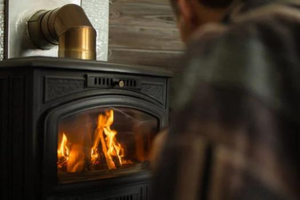
A chimney is the most important element of a heating system, which is responsible for the removal of combustion products and ensures the safety of stoves, fireplaces and boilers. Choosing the right type of chimney affects the efficiency of heating, the service life of the equipment and fire safety. Let's consider the main types of chimneys, their features, pros and cons.
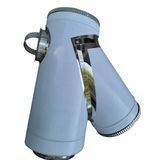
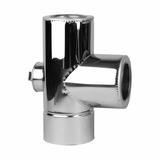
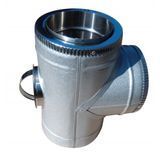
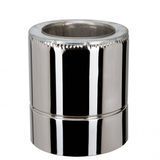
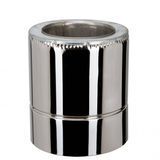
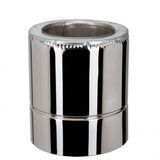
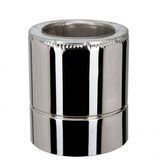
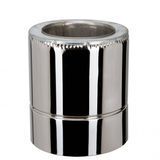
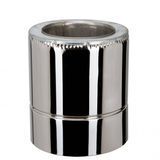
Stainless steel chimney - resistant to corrosion and high temperatures.
Coaxial pipes - used for gas boilers and are not suitable for wood stoves.
Brick chimney - traditional, durable, but requires professional masonry.
Ceramic chimney - the most reliable and durable option, resistant to high temperatures and acids.
Stainless steel chimney: pros and cons
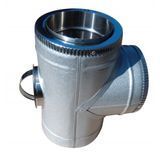
Stainless steel chimneys are one of the most popular options for stoves, fireplaces and boilers. They are lightweight, durable and resistant to high temperatures. Depending on the design, there are single-circuit (without insulation) and sandwich chimneys (two-layer with insulation).
🔹 Advantages of a stainless steel chimney
✅ Corrosion resistance - does not rust and does not deteriorate from condensation.
✅ Ease and simplicity of installation - does not require a foundation, can be quickly installed.
✅ Smooth walls - reduce the accumulation of soot, which reduces the risk of blockages.
✅ Suitable for any heating devices - compatible with wood, gas and solid fuel boilers.
✅ Fast heating - improves traction and reduces condensation.
✅ Safety - in the version with insulation (sandwich chimney) reduces the risk of overheating of walls and ceilings.
🔸 Disadvantages of a stainless steel chimney
❌ Relatively high price – high-quality stainless steel is more expensive than regular steel pipes.
❌ Without insulation, condensation forms – single-circuit pipes can quickly deteriorate due to acidic condensation.
❌ Heating of the outer surface – single-wall pipes require compliance with fire safety regulations (at least 25 cm from flammable materials).
❌ Appearance – does not always fit into the classic style of the house (but can be hidden in a decorative box or brickwork).
Conclusion
Stainless steel chimneys are a universal and practical solution for most heating systems. They are durable, resistant to high temperatures and easy to install. The best option is a sandwich chimney, as it prevents condensation and reduces the risk of overheating.
Ceramic chimney: pros and cons
Ceramic chimneys are modern systems consisting of heat-resistant ceramic pipes, insulation and an outer casing (brick or metal).
🔹 Pros:
✅ High durability (lasts 50+ years).
✅ Resistance to acids and high temperatures.
✅ Good thermal insulation, minimal risk of condensation.
🔸 Cons:
❌ High price.
❌ Complexity of installation - requires a foundation and accurate calculation.
Conclusion
For long-term use and maximum safety, a ceramic chimney is the best choice.
Brick chimney: pros and cons
Brick chimneys are traditionally used in heating systems of private houses, baths and cottages. They are durable, long-lasting and have a classic appearance, but they have their own characteristics that are important to consider before installation.
🔹 Advantages of a brick chimney:
✅ Durability - with proper laying and maintenance, the service life can exceed 50 years.
✅ Aesthetics - a brick chimney fits perfectly into classic and country houses.
✅ Heat capacity - it takes a long time to heat up, but also retains heat for a long time, ensuring stable operation of the stove.
✅ Fire resistance - withstands high temperatures without deformation and destruction.
✅ Versatility - suitable for wood stoves, fireplaces, solid fuel boilers.
🔸 Disadvantages of a brick chimney:
❌ Complexity of installation - requires professional laying in compliance with technology.
❌ Heavy - a separate foundation is required for the stability of the structure.
❌ Formation of condensation - without an internal liner, it can be destroyed due to acids in flue gases.
❌ Low tightness - brickwork cracks over time, which can lead to smoke leakage.
❌ Rough inner surface - traps soot, which increases the risk of blockages and requires regular cleaning.
Conclusion
A brick chimney is an excellent option for stationary heating systems in private homes, but its installation requires high costs and proper maintenance. To improve the characteristics of a brick chimney, it is often lined with ceramic or metal inserts, which increases the service life and reduces the risk of destruction.
Coaxial chimney: pros and cons
A coaxial chimney is a double-circuit pipe designed to work with gas boilers. The inner circuit removes combustion products, and the outer circuit provides fresh air for combustion. This is a modern solution that is often used in gas boilers with a closed combustion chamber.
🔹 Advantages of a coaxial chimney
✅ Compactness - takes up less space compared to classic chimneys.
✅ Two in one - combines a chimney and an air supply system.
✅ Increased safety - no risk of carbon monoxide leakage into the room.
✅ Efficiency - the boiler uses air from the street, not from the room, which reduces heat loss.
✅ Easy installation - does not require a bulky vertical chimney, can be mounted through the wall.
✅ Less condensate – due to the heating of the inner pipe by the outer circuit.
🔸 Disadvantages of a coaxial chimney
❌ Suitable only for gas boilers – not used for stoves, fireplaces and solid fuel boilers.
❌ Limited length – it is not recommended to make the pipe longer than 3–5 meters, otherwise the draft will deteriorate.
❌ Dependence on weather conditions – in strong winds or frost, the boiler may not work properly.
❌ Not always suitable for old houses – requires precise calculations and sometimes complex installation.
Conclusion
Coaxial pipes are an excellent choice for modern gas boilers with a closed combustion chamber. They are safe, compact and energy efficient, but are not suitable for other types of heating devices.
If you need a universal option with easy installation and durability, a stainless steel sandwich chimney or a ceramic chimney will be the best solution.
HRUBA will help you with high-quality installation 📱 0 800 3 35 487, (073) 35 35 487, (097) 35 35 487