Which firewood is best to choose for a fireplace: analysing together with a specialist
A properly selected fireplace system combined with high-quality firewood allows you to create a comfortable microclimate at home. In this article we will consider the nuances of selecting the right fuel, the conditions of its storage and the rules for laying it in the firebox. You will learn which firewood is best to use to achieve maximum heat output, safety and a beautiful flame, how to check the quality of wood and which wood species are considered the most suitable for heating. In addition, we will discuss how to properly organise a place for storing logs in the yard and inside the house so that the wood does not lose its properties and is convenient to use.
A fireplace selected according to its power and appropriate firewood are the basis of home warmth, comfort and a pleasant atmosphere. And while the technical parameters of heating equipment are usually clear, the question of fuel always raises additional clarifications. Do you need special wood for a fireplace, or will any combustible wood be suitable? And are there modern alternative types of firewood?
In the material we will analyse in detail which wood species should be used in a fireplace, how to properly organise the storage of firewood outside the house and indoors, and also how to place logs in order to obtain a bright and stable flame.
Why it is important to choose the right firewood for heating?
Indicators such as operating efficiency, performance and heat output of the device directly depend on the quality of the wood. Even the most expensive and modern fireplace will not demonstrate its potential if unsuitable fuel is used. Burning firewood in a fireplace takes place at approximately 450–1000 °C, and the smouldering process begins already at approximately 300 °C. If the requirements are not followed, the consequences can be negative.
Safety. Incorrect firewood causes intense soot formation, emission of harmful gases, or burns too slowly or too quickly, creating strong sparking. In addition to this there is an unpleasant smell and excessive smoke. This leads to the risk of ignition, uncontrolled burning, darkening of the glass, clogging of the chimney and internal elements of the device.
Efficiency of fireplace use. Wood of different species differs in density, amount of resin and speed of combustion. Some types of wood are generally not recommended for use in fireplaces. Before lighting, it is necessary to familiarise yourself with the recommendations of the manufacturer of a specific model. This is critically important if the fireplace is part of a heating system or water heating.
Emotional perception of live fire. A fireplace is not only a functional element but also a central detail of the interior. A quiet crackling sound, gentle heat and natural aroma of wood are possible only with high-quality firewood.
How to evaluate the quality of wood?
The quality of firewood is the correspondence of the species and properties of wood to the specific type of fireplace. The main factors are: type of wood, heat output, harvesting time, drying and storage conditions, geometry of logs, absence of foreign impurities, moisture. Some characteristics can be assessed visually, but it is also important to choose a trusted solid fuel supplier.
Heat output of different species
The first basic parameter is calorific value, that is the amount of heat and duration of burning. It directly depends on the density of wood: hardwood species burn longer and give more energy. Hardwood species include acacia, hornbeam, oak, ash and maple. Less dense species are aspen, linden, alder, poplar, pine.
For example, oak firewood has 1600–2400 kcal per cubic metre, which corresponds to about 2900 kWh of energy. Heat output is measured in %.
The highest value is in hornbeam and maple — approximately 85%. Oak — about 75%, birch — 68%, aspen — about 51%, poplar — about 39%.
Wood moisture
This parameter is measured in %. The drier the wood is, the better it burns and the more heat it releases. If the wood contains too much water, the majority of the heat is spent on its evaporation.
The optimal moisture level for fireplace firewood is up to 20%. Such indicators are achieved if the wood has been dried under proper conditions for at least half a year, and even better for a year or longer.
Log size for the fireplace
The best result is given by logs of equal size, approximately 7–9 centimetres in diameter and in length equal to 2/3 or 3/4 of the width of the front part of the firebox.
Logs of the same size ensure even burning, do not produce thick smoke and transfer maximum heat. In contrast, poor-quality wood, branches, waste and an excess of bark create soot and products of incomplete combustion, which negatively affects the fireplace and can cause dangerous ignition in the chimney.
Which wood species are most suitable for a fireplace?
For most solid fuel fireplaces it is recommended to use firewood from deciduous trees. Such wood has a dense structure, burns for a long time, gives high heat output and contains little resin, therefore the formation of soot and smoke is minimal.
Oak. Answering the question “which firewood burns the longest” — oak will be at the top of the list. Its wood is dense, heavy, burns slowly, releasing a noble aroma. Oak logs are often mixed with cheaper firewood. Even after burning, long-lasting embers are formed. For harvesting, trunks of medium age are chosen, because trees that are too old give lower heat output.
Alder. Alder logs have an attractive appearance and their cut can have different shades — from yellow and ochre to reddish or bluish. Well-dried wood is stored for a long time without losing its properties. It burns evenly, giving a bright flame, a small amount of smoke and a lot of heat.
Birch. Birch firewood is characterised by high heat output, even and long burning and minimal formation of combustion products. However, it is advisable to harvest it no more than two years in advance. Birch also requires good draft and sufficient air supply, otherwise birch tar may form, which settles on the walls of the combustion chamber.
Pressed briquettes (euro firewood). This is a pressed mass of wood waste, and sometimes also based on peat or carbon raw materials. Such briquettes burn much longer and hotter than traditional logs, do not produce sparks, and are easy to transport and store.
Which types of firewood are not recommended for fireplaces
Raw wood should not be used: it ignites poorly, gives little heat, and most of the energy is spent on evaporating moisture. In addition, condensation forms in the combustion chamber, which together with soot quickly damages the glass and the surfaces of the firebox.
Coniferous wood is not recommended for fireplaces due to the excess of resins. Such logs produce thick smoke, soot actively and burn quickly.
Willow, although cheap, gives almost no heat — it burns instantly. Poplar also has low density and low efficiency, therefore it is usually taken for ignition or only for cleaning the combustion chamber.
How to correctly arrange firewood in a fireplace?
The method of arranging firewood is an important factor that affects the stability of the flame, its safety and the economical use of wood.
The first ignition of the season. It is performed after a long break, for example in autumn. Logs of medium size are chosen. At the very bottom two or three of the thickest pieces of wood are placed, on them several layers of smaller ones. At the end small chips are added, but without garbage or random waste. Each layer of wood is laid perpendicular to the previous one. The height of the pyramid can be half or one third of the height of the combustion chamber. Logs should not be stacked too tightly — air must pass freely between them. On top a cube of special fire starter is placed and lit with matches or a fireplace lighter. At first the fireplace door is closed loosely, allowing the fire to form. The first load of wood must burn completely, and only after a stable layer of embers is formed new logs can be added.
The second load. When the first firewood has burned out, the fireplace door is briefly opened so that the air equalises the pressure. The embers are evenly distributed along the bottom of the firebox with a poker, after which two or three new logs are placed on top. Enough gaps are left between them for ventilation. When the flame ignites and the door is tightly closed, the air supply is reduced by about half to slow down the burning rate.
Firewood should be allowed to burn out on its own. Forced extinguishing is not allowed — it can damage the system, cause smoke or even lead to chimney ignition.
How to properly organise a place for storing firewood?
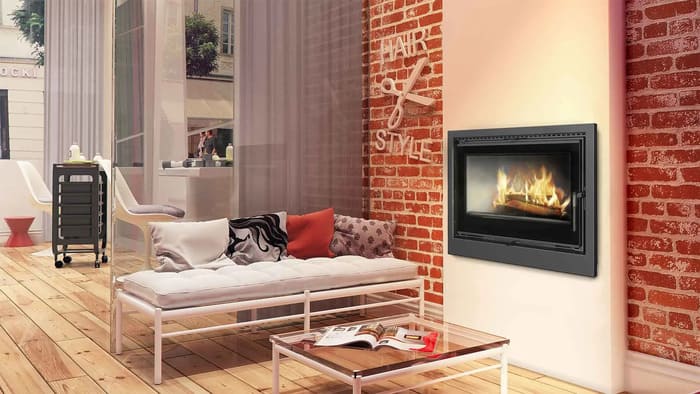
Firewood is not only fuel but also a decorative element of the fireplace zone. For good storage in a room, appropriate log holders are used, which are selected according to the style of the fireplace space. These can be classic forged constructions, minimalist metal stands or various open shelves made of wood or metal.
Large stocks of prepared firewood are stored in several ways. The most common is a canopy outdoors, which protects from precipitation and provides air access from all sides.
Another option is stacking firewood under a canopy near the outer wall of the house. This method looks neat, but it is important to leave a gap between the wall and the wood for ventilation.
Special racks are also used, which do not allow logs to lie on the ground, providing ventilation and protection from getting wet.
There is also an option with a technical room, provided that it is spacious and well ventilated and does not directly border residential rooms. Logs should be stacked so that they are convenient to take and rearrange. Chaotic piling of firewood is not recommended — it takes up a lot of space and can be dangerous.
Basic rules of selection and storage of firewood
For a fireplace, the most suitable firewood is chosen from deciduous trees with high heat capacity — oak, hornbeam, maple, birch. Logs must be dried, uniform in size and free of foreign impurities. For quick ignition, briquettes are added, which burn for a long time and release a lot of energy.
In the room, firewood is placed on special log holders, following fire safety rules. Outdoors it is advisable to store them under a canopy, under the roof of a building or on special stands. A properly organised place for firewood will become a functional addition and decoration of a living space or a country house.